

The documentarian
Culture decoded: Exploring the modern urge to capture

“Excuse me, do you mind taking a photo of us?”
A sentence woven between mundane politeness and intimacy that disappears into public life. You hear it outside art galleries, train stations, cafés spilling onto the pavement as strangers celebrate birthdays, anniversaries, ordinary evenings they want to keep. Suddenly someone’s phone is warm in your hand. For a moment, you are invited into the edge of their memory. Within these suspended seconds of trust, you enter the private geometry of another life.
In this flash, bodies become slightly ceremonial. Friends compress themselves together until there are no gaps left between them. Families tilt inward. Lovers lean into each other with practiced ease. Then somebody asks for a second photo, a more candid one. “Just act natural.” The sentence immediately destroys any possibility of naturalness. Suddenly everybody is aware of their own performance. Smiles harden. Hands lose somewhere comfortable to rest. You become hyperaware of your own face, forgetting what your smile looks likes as if being perceived has interrupted the instinct of existing.
Sometimes I wonder how many lives we exist inside of accidentally, on the outskirts as an unseen figure behind the camera, an extra to the film. Then more broadly to the thousands of photographs stored in our phones, that perpetually get bigger each year. Birthday dinners. A coffee with friends, to a puddle you like the look of. The pixelated proof that this moment happened. There is an intimacy in taking a photograph that feels increasingly at odds with the experience of living through one. Because now the camera arrives before the feeling does.
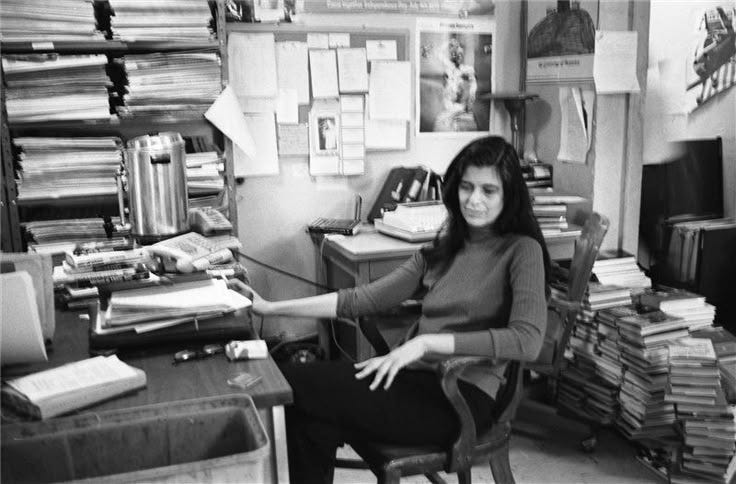
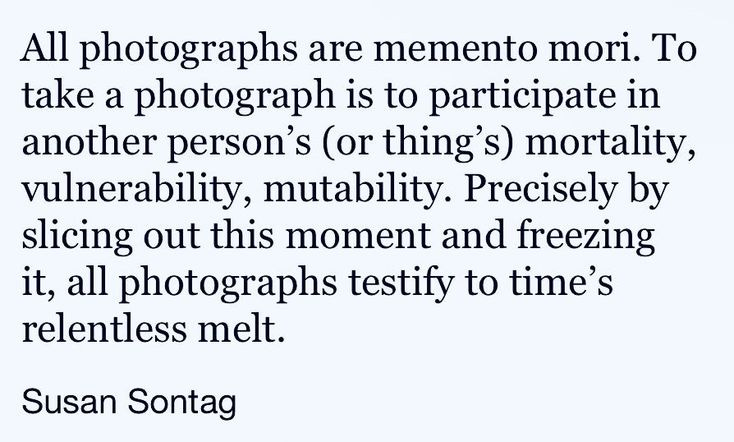
Susan Sontag wrote in On Photography:
“Today everything exists to end in a photograph”
At concerts, entire crowds lift their phones into the air before the music becomes a sensation felt in their bodies. The recent rise of clubs and parties placing stickers over phone cameras feels like a small rebellion against this, an attempt to return people to the experience itself rather than its documentation. Meals are paused before the senses get a taste of the food in front of them, allowing the camera to always be the one to eat first. Sunsets become evidence of living a delicious life. In this constant documentation experiences are flattened under the pressure of being visible experiencing.
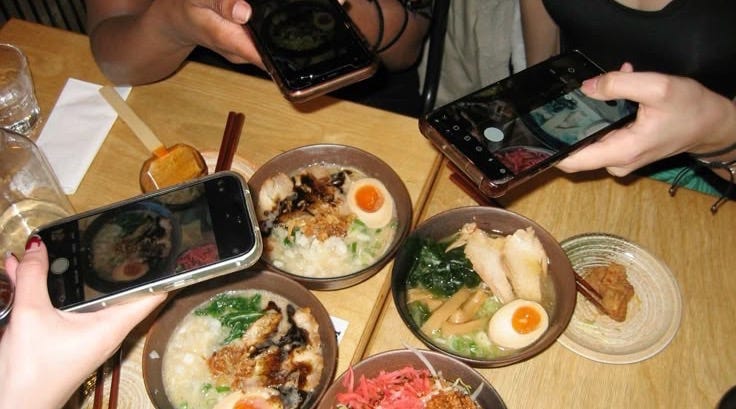
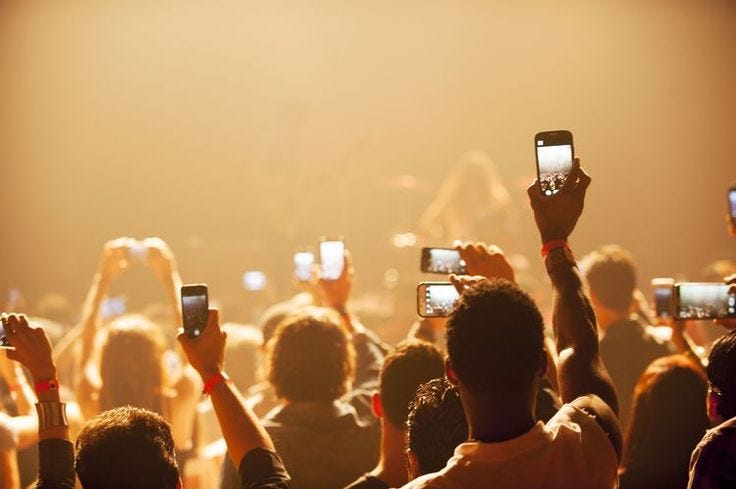
Life increasingly oscillates between an endless cycle of documenting and experiencing. On one side of the coin, recording something can feel like an act of care, evidence that a moment mattered enough to preserve rather than let dissolve into time. Other times the act of capturing can pull you out of the experience itself. The joy of being somewhere often depends on your ability to disappear fully into it, to absorb the texture of the moment without immediately translating it into an image.
The phone, always by your side, has become an extension of the body, the mind and the soul. It demands almost the same level of attention as the self itself. Even now, as I write this in a coffee shop, my phone sits beside me like another presence at the table, waiting to pull me away from the slower, more generative part of my mind. The part that introspects and experiences rather than endlessly absorbs.
There is no revolution to come where the age of the documentarian will end, its too ingrained within the very nature of living, it has become an unconscious reaction to seeing something of interest. We have forgotten to ask who are we documenting all this for? What is the greater point? So our future children can scroll through the tens of thousands of pixels that make up the days, months and years of our lives? Maybe it comes from a part of the human interior that feels overwhelmed by the fleeting nature of living itself. The part that knows moments are special because they don’t happen again, time is constantly moving forwards and you can never go back.
It might be a very human attempt at soothing the brain, If I can see that this happened, maybe I can stay connected to the version of myself that existed inside it. Who I was before all this other stuff happened, to validate both your old identity and linger in your experience with others.
What can be noticed is a compression of experience as moments become manufactured primarily for visual enjoyment, great for the archive but with the heart lost in the process. The part of an experience that makes it memorable is deeply intangible and could never be reduced purely to the visual realm. This is why some experiences can look beautiful yet still feel strangely empty. Surface level in its truest sense. It looks right but feels wrong because every other sensation apart from vision has been abandoned.
If most of the world is felt rather than seen, it would make sense that reducing an experience into a curated pictorial version of memory compresses the texture of that moment itself, and if this becomes the backbone of culture it’s no wonder people feel more disconnected than ever. So much of what makes life meaningful exists outside the visual realm entirely. The atmosphere in the air. A feeling in your body. The energy between people. Things impossible to fully document.
The best part of life is that it’s not fully recountable, so to behave like it brings a strange incongruence to the natural flow of life itself. Maybe it becomes a question of discomfort with mortality. We are only able to experience things once, in the present, and part of what makes life precious is the uncertainty that tomorrow is even coming.
Humans have always drifted between memory, anticipation and presence, but technology collapses those states into each other at a speed the body can barely process. We are no longer just experiencing moments as they happen, but simultaneously documenting them, curating them and imagining how they will later be remembered.
Before it became possible to document life in such an automatic way, people still collected and shared stories, drew images onto walls, passed memories between each other through conversation. The act of sharing was once just as rich as the act of witnessing itself.
The issue with modern witnessing is that beneath access to other people’s lives exists a deeply curated version of reality. This filtering and performance leads to deep-seated comparison. There is an inauthenticity, only the performed version is posted and the feeling isn’t felt by others.
Urgency arrives with the phone. You are no longer granted the grace of taking your own time to share, your own time to connect with others, your own time to disappear for a while. The phone as an extension of the human means we are expected to remain constantly switched on and emotionally available to reply, receive, document and respond even when we are nowhere near at capacity to do so.
Cheapening can happen when you give your experience away too quickly. In choosing one image to represent the entirety of an experience, something of infinite texture and emotional value becomes reduced into a post. You hear people speak about not posting their wedding day because trying to capture something so emotionally significant feels impossible, almost diminishing in itself.
If words can cheapen experience, photographs can too. Some things aren’t meant to be fully replicated outside of the moment they were lived in. They have to stay with the people who were there. The energy can stay in the room.
There has to be a way to change the zeitgeist’s relationship to the incessant compression of experience through documentation. Documentation as another channel of creation that doesn’t completely interrupt the present. To bring back the art of archiving a feeling or a stage in time in a way that makes the process itself the richer experience rather than just the outcome.
In this way maybe intimacy can return to life again. If the mind has the ability to filter every moment, maybe it also has the ability to tune itself into the texture that makes life feel present and alive rather than simply visible.
Does documentation genuinely add richness to our experience of living, at what point does it begin to distance us from life itself?
Would love to continue the conversation on this topic in the comments, any further insights, perspectives or examples in your life experience where this shows up.
Thanks a lot for reading! If you enjoyed, I post weekly on culture, creativity and self-inquiry. Reach me at ninavincentx@outlook.com or @n1naaxoxo on instagram.
your writing is so gorgeous!! i feel the pressure to document my existence for approval sometimes, especially over holidays or long weekends. do my plans live up to other peoples expectations? i should post because people might think i have nothing to do…
i’m trying to take a concious step back to consider what is worthy of documentation, and why it matters to me (and only me)
This was honestly so well-written and interesting, I loved it!